We will be closed from 5pm BST on Thursday 2nd April for the Easter bank holidays, re-opening at 8.30am BST on Tuesday 7th April. Any orders placed during this period will be processed when we re-open.
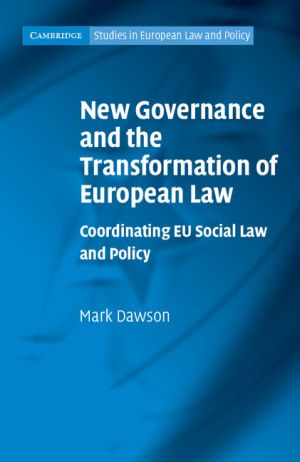
The development of non-binding new governance methods has challenged the traditional ideals of EU law by suggesting that soft norms and executive networks may provide a viable alternative. Rather than see law and new governance as oppositional projects, Mark Dawson argues that new governance can be seen as an example of legal 'transformation', in which soft norms and hard law institutions begin to cohabit and interact. He charts this transformation by analysing the Open Method of Coordination (OMC) for Social Inclusion and Protection. While this process illustrates some of the concrete advantages for EU social policy which new governance has brought, it also illustrates their extensive legitimacy challenges. Methods like the OMC have both excluded traditional institutions, such as Courts and Parliaments, and altered the boundaries of domestic constitutional frameworks. The book concludes with some practical suggestions for how a political 'constitutionalisation' of new governance could look.