The eBooks we sell are sold as a single-user licence and are intended for the end user only.
The sale of some eBooks are restricted to certain countries. To alert you to such restrictions, please select the country of the billing address of your credit or debit card you wish to use for payment.
For further information see https://www.wildy.com/ebook-formats
Once the order is confirmed an e-mail will be sent to you to allow you to download the eBook. For UK purchases this will be automatic. For purchases outside the UK a member of staff will need to confirm the sale. (Staff are available to do this during normal business hours, Mon-Fri 8:30-17:00 UK time)
All eBooks are supplied firm sale and cannot be returned. If you believe there is a fault with your eBook then contact us on ebooks@wildy.com and we will help in resolving the issue. This does not affect your statutory rights.
Due to a technical issue some ebooks are not available to order.
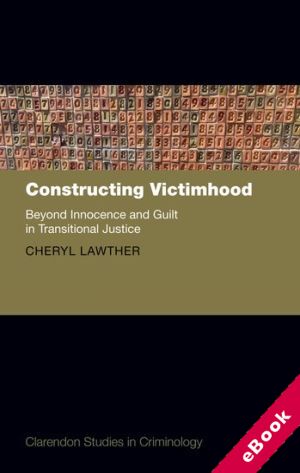
Constructing Victimhood seeks to go 'beyond innocence and guilt' to expand the criminological, victimological, and transitional justice image of who we 'see' as victims, what we 'hear' as experiences of victimisation, and who makes these determinations.
The book argues that the construction, reproduction, and politicisation of victimhood is structured not only by notions of innocence and guilt and the existence of complex victims, but by larger questions concerning the existence of complex hierarchies of victimhood that supersede simplistic notions of 'good' and 'bad' victims. Lawther also considers the exercise of voice, the role of silence and the silencing of certain variants of victimhood (in gender-based crimes for example), the politicisation of victims' groups and the impact of unresolved legacies of violent conflict. The author argues that in the failure to cast the transitional justice gaze more widely it is not only the 'voices in the cracks' that will be overlooked, but entire experiences of victimhood and victimisation.
If transitional justice is to live up to its claims of being 'victim centred', widening its conceptual and practical boundaries to recognise the multiple and overlapping variables that construct and reproduce victimhood is essential. Pursuing this line of enquiry, Constructing Victimhood aims to change our understanding of victimhood in post-conflict and transitional contexts.