The eBooks we sell are sold as a single-user licence and are intended for the end user only.
The sale of some eBooks are restricted to certain countries. To alert you to such restrictions, please select the country of the billing address of your credit or debit card you wish to use for payment.
For further information see https://www.wildy.com/ebook-formats
Once the order is confirmed an e-mail will be sent to you to allow you to download the eBook. For UK purchases this will be automatic. For purchases outside the UK a member of staff will need to confirm the sale. (Staff are available to do this during normal business hours, Mon-Fri 8:30-17:00 UK time)
All eBooks are supplied firm sale and cannot be returned. If you believe there is a fault with your eBook then contact us on ebooks@wildy.com and we will help in resolving the issue. This does not affect your statutory rights.
Due to a technical issue some ebooks are not available to order.
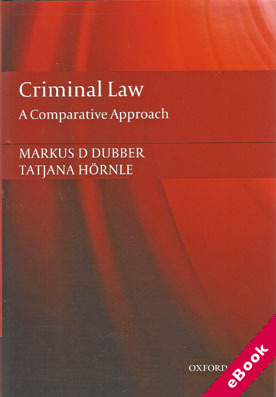
Criminal Law: A Comparative Approach presents a systematic and comprehensive comparative analysis of the substantive criminal law of two major jurisdictions: the United States and Germany.
Presupposing no familiarity with either U.S. or German criminal law, the book will provide criminal law scholars and students with a rich comparative understanding of criminal law's foundations and central doctrines. All foreign-language sources have been translated into English, cases and materials are accompanied by heavily cross-referenced introductions and notes that place them within the framework of each country's criminal law system and highlight issues ripe for comparative analysis.
Divided into three parts, the book covers foundational issues - such as constitutional limits on the criminal law - before tackling the major features of the general part of the criminal law - and a selection of offences in the special part. Throughout, readers are exposed to alternative approaches to familiar problems in criminal law, and as a result will have a chance to see a given country's criminal law doctrine, on specific issues and in general, from the critical distance of comparative analysis.