The eBooks we sell are sold as a single-user licence and are intended for the end user only.
The sale of some eBooks are restricted to certain countries. To alert you to such restrictions, please select the country of the billing address of your credit or debit card you wish to use for payment.
For further information see https://www.wildy.com/ebook-formats
Once the order is confirmed an e-mail will be sent to you to allow you to download the eBook. For UK purchases this will be automatic. For purchases outside the UK a member of staff will need to confirm the sale. (Staff are available to do this during normal business hours, Mon-Fri 8:30-17:00 UK time)
All eBooks are supplied firm sale and cannot be returned. If you believe there is a fault with your eBook then contact us on ebooks@wildy.com and we will help in resolving the issue. This does not affect your statutory rights.
Due to a technical issue some ebooks are not available to order.
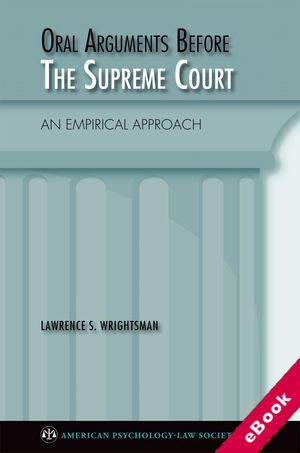
When the Supreme Court agrees to decide a case, the litigants make an (usually one-hour) oral presentation to the Court. In all the steps in the Court's decision, this is the only public part. As such, it provides an important window into the Court's decision-making processes. Using original transcripts from the last 8 sessions of the Supreme Court, Wrightsman's empirical research is the first of its kind.
The purpose of this book is to examine how the oral arguments work, and their effect on the Court's decisions. It also draws the important distinction between ideological cases (i.e. hot-button issues such as the death penalty, affirmative action, abortion, and the environment) and non-ideological cases (bankruptcy, tax code, civil litigation), and shows the different ways in which they're treated.